A profession in constant evolution
Each year, the American Physical Therapy Association (APTA) conference brings together experts in physiotherapy and rehabilitation from around the world. On site, I saw just how quickly our profession is evolving across multiple areas: sports performance, joint replacement, concussion management, and artificial intelligence in health care.
Beyond trends, one essential question guided my reflections: what do these advances truly change for our patients? Here are four key highlights.
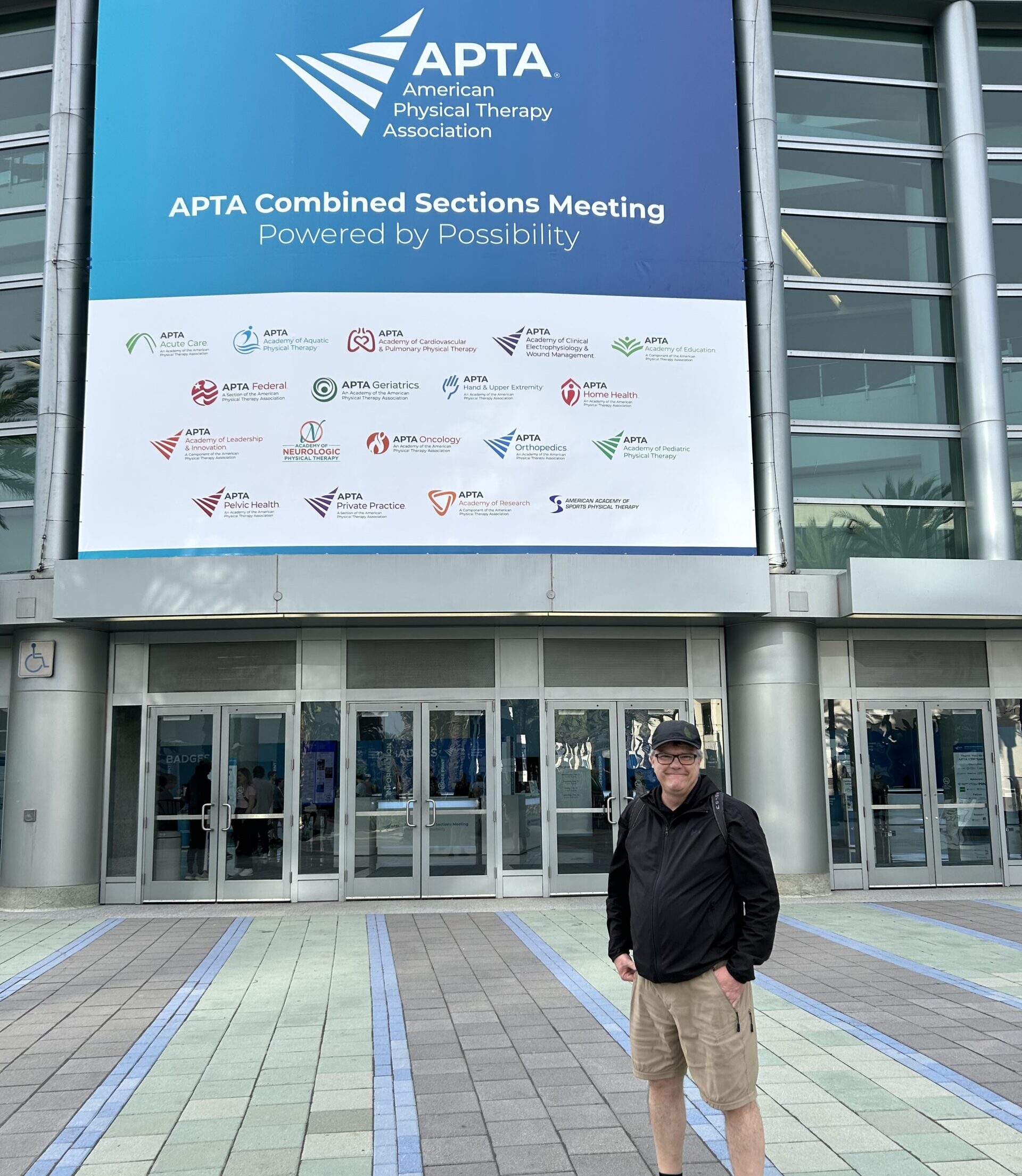
Denis Pelletier, Fellow physiotherapist, M.Sc., at APTA 2026
1. Elbow injuries in throwing athletes
Tommy John surgery
In 2023, there were more Tommy John surgeries among professional pitchers than during the entire decade of the 1990s.
This procedure repairs a torn ulnar collateral ligament in the elbow, the structure responsible for stabilizing the joint during throwing motions. While especially common in baseball pitchers, this injury can also affect tennis players, football quarterbacks, or anyone performing repetitive overhead movements.
Tommy John was a professional baseball pitcher who, in 1975, became the first well-known athlete to undergo reconstructive surgery of this ligament. Since then, the procedure has commonly been referred to as Tommy John surgery.
Article you may find helpful: How to prevent the most common baseball injuries
A shift in mechanics
In high-level sport, pitch velocity and spin continue to increase. Data presented at the conference show a clear correlation: the faster the ball is thrown and the greater the spin, the higher the risk of elbow injury.
An interesting biomechanical factor also emerged. Pitchers whose arm follows a more vertical path appear to be at lower risk than those throwing with a more horizontal trajectory.
Why does this matter? Because these findings allow for earlier intervention:
- Precise analysis of athletic mechanics
- Personalized prevention programs
- Rehabilitation tailored to real biomechanical demands
For athletes, both amateur and professional, this means more targeted and effective sports physiotherapy focused on sustainable performance.
Will this research lead to fewer Tommy John injuries and surgeries? Time will tell, but the outlook is encouraging.
Source: HA-23813 The evolution of Tommy John surgery: A brace centric surgical approach with considerations for rehabilitation (CSM APTA Anaheim 2026)
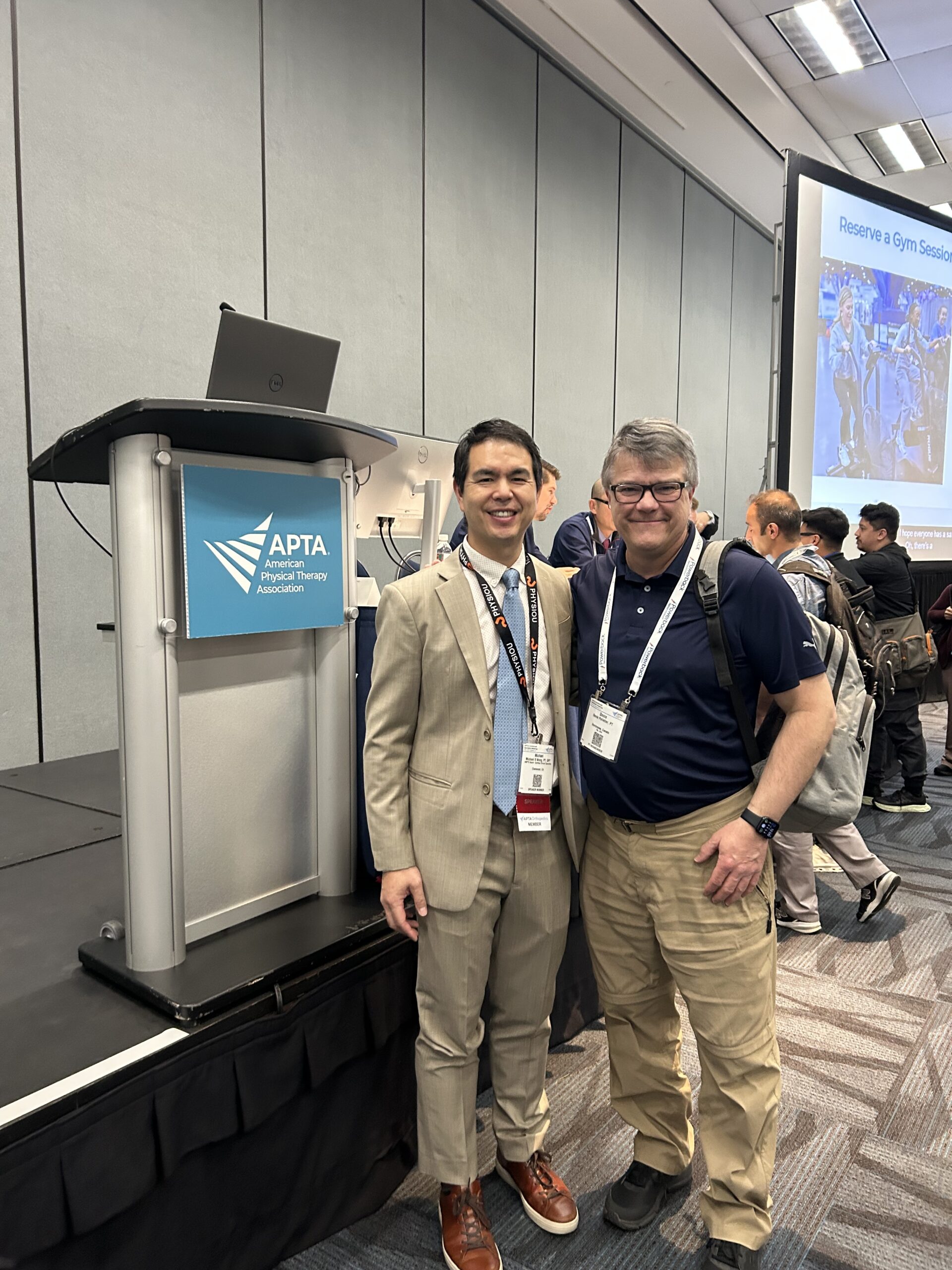
With Michael Wong, PT, DPT, following his presentation on shoulder injuries in throwing athletes.
2. Total shoulder replacement
Whether anatomical or reverse, rehabilitation after total shoulder replacement is evolving toward a more progressive approach.
Current research recommends:
- Immobilization for 3 to 6 weeks
- Controlled mobility while initially avoiding external rotation
- Strengthening introduced later, often after 8 weeks
This approach reflects a better understanding of the mechanical and biological stresses surrounding the implant.
Observed outcomes include:
- Improved patient comfort and safety
- Reduced risk of complications
- Better protection of healing tissues
- Gradual and safe progression
In rehabilitation, strategic patience can help ensure long-term results.
Source: OR-23840 Enhancing the value of PT in the management of glenohumeral osteoarthritis: evidence, controversies and innovation (CSM APTA Anaheim 2026)
3. Concussion
One of the most impactful presentations focused on negative neuroplasticity following a concussion.
A brain injury can trigger a complex cascade: altered neural circuits, balance disturbances, hypersensitivity, cognitive fatigue, and decreased functional capacity.
The good news? This process is reversible.
However, it requires:
- A thorough neurological physiotherapy assessment
- A multimodal approach
- Consistent engagement in rehabilitation
These findings reinforce that concussion management must be individualized and structured, addressing all dimensions of the nervous system.
Source: NE-24102 Negative neuroplasticity: Unravelling the connection between maladaptive strategies, cortical reorganization and persistent symptoms post concussion (CSM APTA Anaheim 2026)
4. Artificial intelligence
Unsurprisingly, artificial intelligence in health care was central to discussions. Rapid access to scientific literature, clinical decision support tools, and optimized documentation processes offer significant possibilities.
Two major issues were raised:
- True mastery of these tools
- Ethical considerations and data protection
In my view, AI can support clinical practice, but it will never replace clinical judgment or the therapeutic relationship. I also noted renewed interest in certain physical modalities, such as therapeutic laser, with increasingly precise indications.
Source: LI-23970 Artificially intelligent: AI and data is raise the floor on clinical practice in learning health system (CSM APTA Anaheim 2026)
A clinician’s perspective
What struck me most at APTA 2026 was the importance of maintaining a diverse clinical toolbox and strong critical thinking skills. Technology is advancing rapidly, but it does not always simplify practice.
Whether in neurological rehabilitation, post-surgical care, or sports physiotherapy, the challenge is not to adopt every new innovation, but to select those that provide real, measurable, and safe benefits for patients.
Innovating to better support your rehabilitation
The advances presented at the conference confirm that modern physiotherapy continues to evolve quickly. At PhysioExtra, our commitment is clear: integrate relevant innovations, pursue ongoing education, and apply new knowledge with rigour and compassion.
At the heart of every protocol and every technology is a person seeking to regain function, confidence, and quality of life.