
1. You should stretch before playing sports
False. Static stretching, meaning holding a position for a prolonged period, does not prevent injuries and does not provide an effective warm up before sports.
Research shows that prolonged stretching of muscle fibers can reduce power and strength, which may negatively affect athletic performance. This is especially important for sports that require explosiveness, power, or rapid acceleration, such as soccer or hockey.
The main exception involves sports that require a large range of motion, such as gymnastics or ballet, where athletes must prepare to reach these positions during performance.
Static or ballistic stretching: what is the difference?
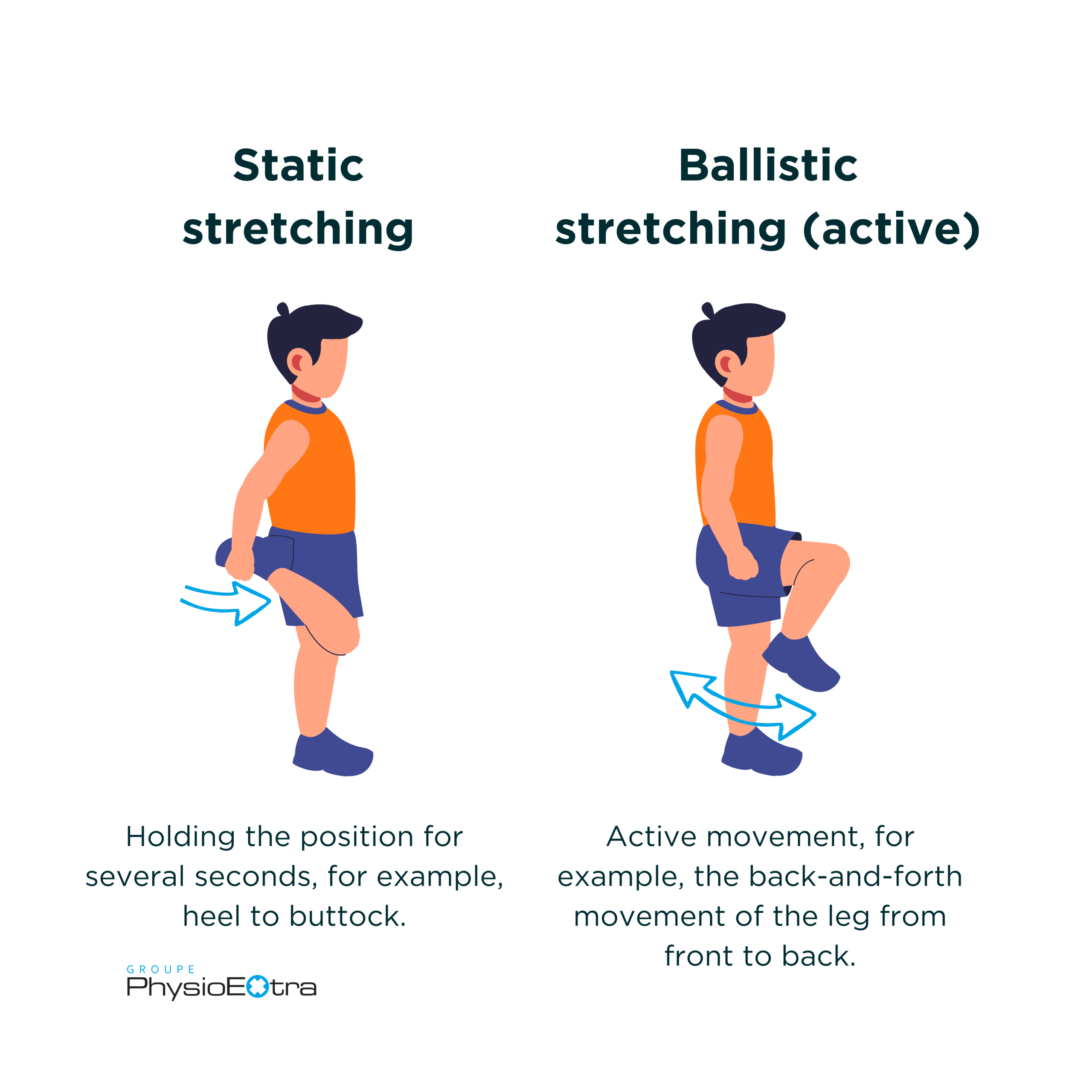
An effective warm up must activate the cardiovascular system. Static stretching does not provide this activation. However, ballistic or active stretching can be used before sports.
Ballistic stretching is performed through movement and is not held. Movement helps activate the cardiovascular system and prepares the body for physical effort. It remains important to properly isolate the targeted muscle and avoid compensations, such as using the back to increase the range of motion of a leg movement.
Static stretching involves holding the same stretch position for several seconds, usually 30 seconds or more.
Ballistic stretching involves repeating a movement, often in a swinging motion, to gradually increase range of motion while warming up the body.
2. Stretching after sports reduces muscle soreness
False. Studies show that stretching after exercise does not prevent muscle soreness. After intense and prolonged effort, muscle fibers naturally sustain microtears that should not be stretched immediately.
In some cases, stretching right after sports may even be harmful. A proper cool down phase is still beneficial to gradually return the cardiovascular system to a resting level, such as light walking after a run or low intensity stationary cycling after a gym workout.
3. Everyone should stretch
False. Some people benefit from improving flexibility in specific muscle groups, while others naturally have sufficient mobility.
Genetics, lifestyle habits, sports practiced, and personal goals all influence whether stretching is necessary. It is not always required to stretch the entire body. A physiotherapist can help identify which muscles may truly benefit from stretching.
4. It is always good to stretch a painful area
False. If pain is caused by reduced nerve mobility or by a muscle that is weak and tight due to protective tension, stretching may be ineffective or even worsen symptoms.
Pain can have many different causes, and stretching is not always the solution. Strengthening, stabilization, or other types of exercises may be more appropriate depending on the situation.
5. It is always good to stretch stiffness
False. Stiffness is not always muscular in origin. It may also come from the joints or the nervous system.
Neurodynamic stiffness often causes symptoms such as sharp pain, pulling sensations, tingling, or numbness in an arm or leg. Joint stiffness is usually felt more locally.
Identifying the source of stiffness is essential to choosing the appropriate treatment. Depending on the cause, mobility, strengthening, or stabilization exercises may be more effective than muscle stretching.
6. Stretching improves muscle flexibility
True, if certain conditions are met.
- The stretch must be held for at least 30 seconds to 1 minute.
- The targeted muscle must be properly isolated without compensation.
- The stretch should be pain free.
- The stretch should be performed regularly, ideally every day.
Depending on the sport, good muscle flexibility may be required to perform certain movements. Improving flexibility in a stiff muscle can also enhance performance and posture, as long as stretching is not done immediately before or after sports.
7. It is possible to stretch too much
True. Stretching can be beneficial, but it should be part of a balanced approach. The body also needs strength and stability.
This is especially important for people who are hyperlax or hypermobile, as excessive stretching over time can become a source of pain. The goal is to combine stretching with strengthening and stabilization exercises, adapted to your profile and condition.
Not sure which stretches are right for you? A physiotherapist can guide you and create a personalized plan. Book an appointment with PhysioExtra today.