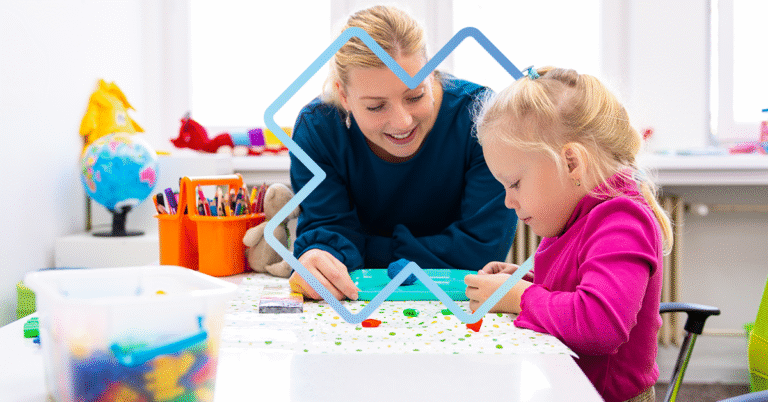
A child’s motor development is a fascinating process that unfolds in several stages, each marking a new achievement in strength, coordination, and confidence. From the very first months of life, babies explore their environment through movement, first through simple reflexes, then through increasingly precise and coordinated actions. What matters most is not the exact age at which a skill appears, but the smooth progression from one stage to the next, based on each child’s individual abilities and needs.
Understanding your child’s gross motor development
Each child develops at their own pace. The information below reflects reference norms based on averages. Several factors can come into play and may positively or negatively influence motor development:
your baby’s baseline muscle tone,
your child’s temperament,
the sources and frequency of stimulation,
complications during pregnancy or delivery,
the family environment.
Is my baby experiencing a motor development delay?
There are still general guidelines regarding when a baby should acquire a motor skill—and, above all, a logical sequence of progression to follow. All babies should go through the same motor development stages, but not necessarily at exactly the same time. For example, your child may crawl on hands and knees at 11 months instead of the “standard” 9 months. That doesn’t necessarily mean they have a concerning motor development delay.
Pediatric physiotherapy
To find out, it may be helpful to have an assessment in pediatric physiotherapy to determine whether this still falls within typical motor development, or whether exercises and additional follow-ups could be beneficial. In physiotherapy, we focus mainly on whether the child has the prerequisites needed to move on to a more advanced developmental stage. If they don’t, we will work to provide extra support so they can develop smoothly.
It’s also important to note that the greatest variability in children’s motor development is seen between 9 and 15 months.
Est-ce que les chaises vibrantes nuisent au développement de notre bébé ? Janie Chrétien, physiothérapeute en pédiatrie chez Physio Extra, a répondu à toutes nos questions sur le développement moteur des enfants.
Major motor development milestones from 0 to 5 years
A 3-month motor delay in a baby under 6 months old is much more concerning than the same delay in a 2-year-old. In practice, a 2-year-old with a 3-month delay would not be considered to have a motor delay, whereas a 6-month-old baby with a 3-month delay would be considered to have a significant delay. The younger children are (especially under one year old), the more consistent milestones should be and the more they tend to occur around the same time from one baby to another.
For a premature baby, you should take their corrected age into account up to age 2. In other words, you use the expected due date to calculate age, as if the baby had been born on that date. For example, a premature baby who is 5 months of chronological age but 3 months of corrected age should follow the developmental milestones of a 3-month-old baby—not a 5-month-old.
1 month
At this age, baby still sleeps a lot, even during the day.
On their back, baby turns their head toward light and high-contrast black-and-white objects. They kick in the air and usually keep their legs curled up. Their fists are mostly closed and they move their arms in an uncontrolled way.
On their tummy, they lift their nose just enough to turn their head to both sides. Their head is most often turned to the side. They tolerate the position for more than 5 minutes at a time.
2 months
On their back, baby follows objects, faces, and lights with their eyes, turning their head from side to side. They lift their legs into the air. They still move their arms in an uncontrolled way, but can more easily bring one hand at a time to their mouth. Their fists are still mostly closed, but they may manage to open them. They are also much more alert.
On their back, baby may still have difficulty keeping their head centered. It is more often turned to one side or the other.
On their tummy, they lift their head to about 45 degrees from horizontal. They may keep it centered or turned. They tolerate the position for at least 5 minutes at a time.
In a seated position, their head is still bobbing.
3 months
On their back, baby brings both hands to the midline at the same time (to their tummy and into their mouth), which supports body exploration. They start to hold their head well centered and can tuck their chin to look at an object on their tummy. Their hands are generally open. They can hold a rattle for a short time, but don’t yet know what to do with it. They track objects and faces very well, turning their head smoothly.
On their tummy, they lift their head to about 60–75 degrees from horizontal and support themselves on their forearms, with elbows level with the shoulders. They can keep their head centered while on their tummy. They tolerate the position for more than 5 minutes at a time.
When seated and supported by an adult, they control their head most of the time, though it may occasionally tip slightly forward.
They may accidentally roll from tummy to back, but this is not required.
4 months
On their back, baby plays with their hands and may sometimes touch their knees by bending their legs. They can grasp an object above them using both hands and hold it. Their head is well centered and can move in all directions. They bring everything to their mouth.
On their tummy, they push up on their forearms and make small weight shifts. Their head is lifted to 90 degrees from horizontal. They tolerate the position for 5–10 minutes at a time.
When seated and supported by an adult, they fully control their head. It no longer bobs.
They may sometimes roll onto their side by bringing their legs toward their abdomen. They don’t yet have enough strength to roll fully onto their tummy.
They may roll from tummy to back, but it often happens accidentally due to the head rotating too far.
5 months
On their back, baby brings their hands to their knees and sometimes their feet to their mouth. They can roll onto their side and hold objects firmly in their hands. They usually use both hands to grasp an object. On their back, they may also push with their feet to lift their pelvis.
On their tummy, they support themselves on their hands or forearms and lift their head fully. In this position, they can also shift weight and gently rock side to side. They tolerate 10 minutes at a time in this position.
In sitting, they may start to hold the position for a few seconds when propped forward on their hands.
Some babies can roll from back to tummy.
6 months
On their back, they easily grab their feet with their hands or bring them to their mouth.
They roll from back to tummy and usually enjoy being on their tummy. In this position, they can free one hand to grasp an object placed near them. They may even pivot or scoot backward at times.
Baby can stay lying on their side and play in this position.
They can sit independently with or without hand support, under parental supervision. They hold it for seconds rather than minutes. They frequently tip to the sides or backward.
7 months
At this age, baby moves more to explore their environment rather than simply taking toys that are handed to them.
They don’t stay on their back for long because they enjoy being on their tummy and may move by pivoting or creeping.
Their favorite position is on their tummy, and they push up easily on their hands with straight elbows.
They hold a seated position without hand support on the floor or back support and can play this way for several minutes. A cushion behind them is still helpful, as they may still fall backward.
They may sometimes start getting into a hands-and-knees position and rocking.
8 months
Baby no longer stays on their back. They roll onto their tummy and enjoy sitting or getting into a hands-and-knees position to play. They usually play less on their tummy than at 7 months because they prefer sitting.
They typically move by belly crawling, but not all babies will belly crawl. Some will wait for hands-and-knees crawling. At minimum, they pivot on their tummy to reach an object. Some also move by rolling from back to tummy and vice versa.
Baby can get into a hands-and-knees position from tummy time and hold it, but may not yet crawl on hands and knees.
They sit with an upright back and their leg position varies. Sometimes legs are outstretched; other times one is bent and the other more straight. They should not always keep their legs in only one position without moving them.
They begin to release objects voluntarily. They manipulate them, transfer them from one hand to the other, and can drop them into a bucket. They may manage to bang two objects together.
The child may sometimes pull to stand using their arms and a couch, for example, but they are not yet aware of danger. Close supervision is essential.
9 months
Many variations can be observed at this age. Some babies are more active movers and others are more observant. Two children with the same abilities may not show the same activities or the same developmental stage.
Generally, baby no longer really plays on their back or tummy. Their favorite position is sitting, alternating with hands and knees.
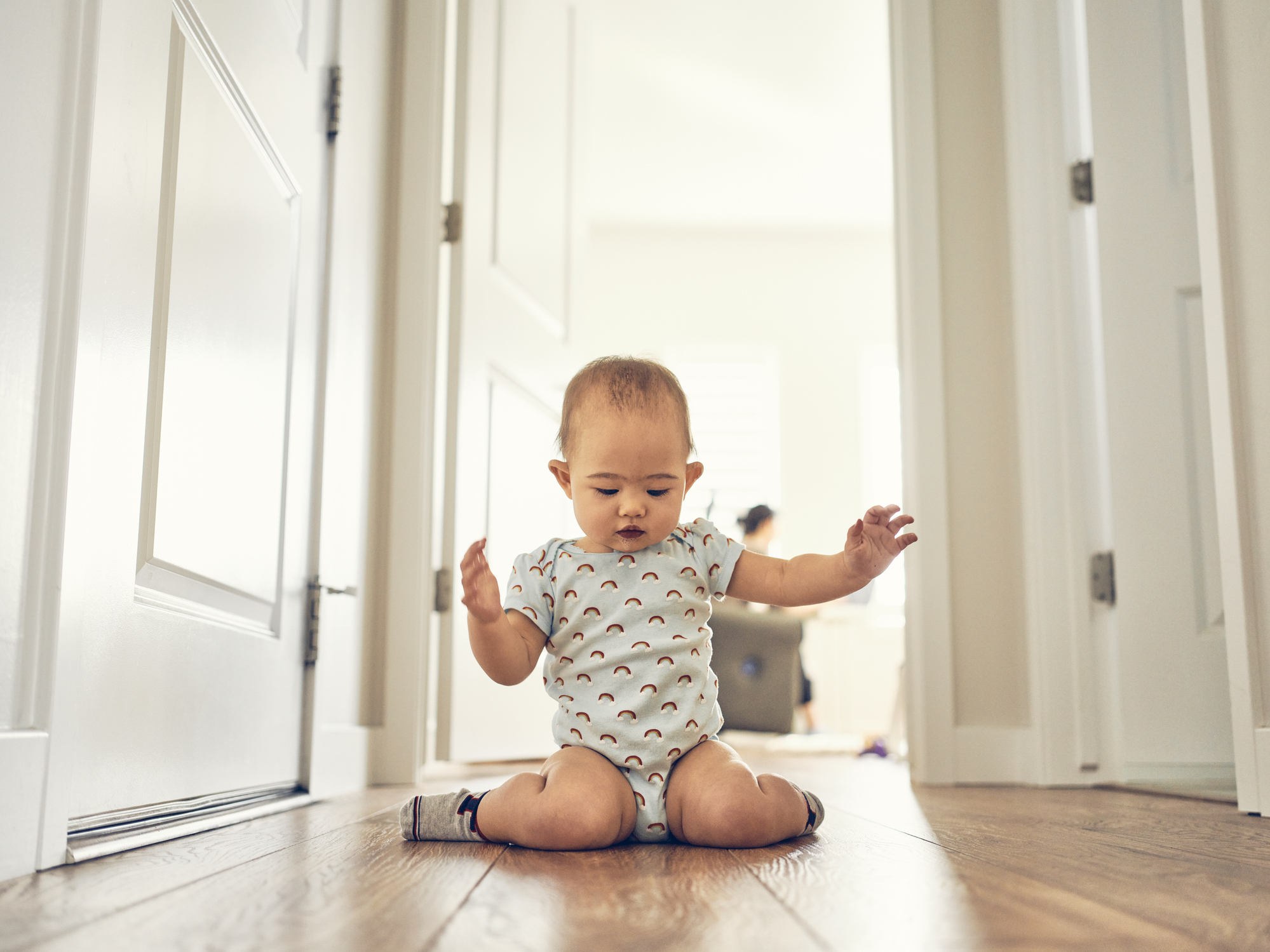
Generally, baby crawls on hands and knees easily and transitions out of the position to sit back down or kneel.
They can hold a kneeling position if holding onto furniture or a small bench. They may try to climb onto a small bench or up stairs, but they are not yet aware of danger. Close supervision is essential.
Most pull to stand with hands supported on furniture and stand with support from one or two hands.
In sitting, they rarely stay still and enjoy releasing toys and dropping them on the floor.
At this age, children may sometimes use W-sitting. While it’s normal to use this position occasionally, it shouldn’t be used frequently because it increases hip rotation and can even create knee instability. You should therefore correct your child when this becomes a habit and bring their legs forward.
10 to 11 months
At this age, the child enjoys manipulating toys as well as emptying and filling a container. They may start pointing with their index finger.
They no longer play on their back or tummy.
They transition frequently from one position to another (sitting, hands and knees, standing, squatting, kneeling, etc.).
Hands-and-knees crawling remains their main mode of locomotion, and they now climb stairs and onto a small bench easily. They begin to recognize danger and can tell which object is too high to climb and which is not.
They can now kneel without using their hands for support.
They pull to stand independently with hands supported on furniture, and interest in standing increases.
They also play while standing with one-hand support to control balance. Sometimes they can stand with their trunk supported on furniture while manipulating an object with both hands. They can squat to pick up an object from the floor. From standing, they start learning to sit back down with control.
They move sideways along furniture and sometimes with a push walker.
12 months
Their favorite position is standing.
They still return to hands and knees when they want to move quickly.
If they aren’t walking yet, they move a lot along furniture, walls, and with a push walker.
They can do a squat with or without hand support to pick up a toy from the floor and then stand back up.
They pull to stand with or without support and begin independent walking. Independent walking typically occurs between 12 and 18 months depending on the child’s acquired developmental steps. Some babies will walk at 10 months and others at 15–16 months, depending on each child’s muscle tone, outside stimulation, personal experience, temperament, and many other factors. What matters is that each child succeeds in the previous developmental steps before starting a new one.
13 to 15 months
The child continues to develop independent walking. Arms are often held up while walking.
They can carry objects in their hands. Falls are still common at this age, but children rarely get hurt because they learn how to fall well and have developed protective reactions.
They can play in a squatting position.
They may still crawl on hands and knees when they want to move faster.
A favorite activity is often putting objects into a container and emptying it.
It’s important for the child to develop the muscles of their feet so the arch can form (the arch is typically fully formed around 4 to 5 years). For a child with typical motor development, the best option is to let them walk barefoot on the floor, in grass, or in sand. Stiff shoes aren’t necessary at this age, as they can make the foot “lazy.” Foot muscles won’t work enough if they’re “trapped” in a shoe all day.
Note: for some children with a motor delay, small boots may be recommended. A physiotherapist can assess your child and advise what’s best on a case-by-case basis.
18 months
The vast majority of children this age have started walking as their main mode of getting around.
They can usually step over a small obstacle (about 5 cm high) without falling.
They carry objects while walking, begin walking backward, and start running (which looks more like a fast walk).
They climb stairs independently—either on hands and knees or standing sideways while holding on with both hands—and go down either on hands and knees, on their bottom, or standing sideways while holding the railing with both hands.
They can sit independently on a small chair or an adult chair, or climb onto the couch.
They climb on and off a ride-on toy truck by themselves.
2 years
The child can now run and stop without losing balance or falling.
Falls may still be frequent at this age because the child is between walking and running. However, they typically don’t hit their head when they fall and protect themselves with their hands.
They can stand on tiptoes for a few seconds and take a few steps on tiptoes.
They can now kick a ball without holding on. They start throwing a ball with both hands.
On stairs, they can go up and down independently while holding the railing with one hand, without alternating feet.
They start jumping in place and jump off the last stair step with one foot leading.
3 years
The child runs while changing direction, going around obstacles, and going up and down slopes. Falls become increasingly rare.
They can briefly stand on one foot, for example while a parent helps remove socks.
They go up stairs holding on with one hand while alternating feet, but go down holding on without alternating feet.
The child can now ride a tricycle or balance bike, steer it, and often loves climbing playground structures.
They now jump off the last stair step with both feet together and can do several consecutive two-foot jumps.
They throw a ball well and occasionally catch it.
4 years
At this age, the child can balance on one foot for about 5 seconds.
They go up and down stairs without holding on, alternating feet.
They can jump with both feet together into hoops and may manage 1 to 5 consecutive hops on one foot. They can easily jump down from a small bench or an adult chair.
With a ball, they can throw and catch with or without a bounce, and start throwing and catching a tennis ball.
They ride a bicycle with training wheels and love climbing playground structures.
5 years
A child this age can balance on one foot for about 5 to 10 seconds.
They go up and down stairs without holding on, alternating feet.
They can do 5 to 10 hops on one foot. They may play hopscotch.
They begin riding a bike without training wheels and can now be part of a sports team and understand the rules of the game.
They easily throw and catch a ball and a tennis ball with or without a bounce.
They begin to dribble a basketball for 1 to 5 consecutive bounces.
Are there certain types of movement to avoid for a baby?
There are certain types of movement or motor patterns to avoid, and they can also be signs that it may be time to consult in pediatric physiotherapy.
At a certain point, a baby will usually try to move to reach a toy. When that moment comes, they will choose the easiest and least demanding way to get there from a muscular standpoint. However, it’s possible that this way isn’t ideal and may reflect weaker muscle strength.
Here are examples of movements or positions that should be assessed in pediatric physiotherapy:
a baby who moves on their back by pushing with their feet on the floor,
a baby who belly crawls using only one side of their body,
a baby who moves while sitting on their bottom, whether or not they bear weight through their hands,
a baby who crawls on hands and knees but bears weight on one foot instead of having weight on both knees,
An early motor developer is a baby who goes through developmental stages faster than the norm. It’s a baby we can place on the floor and who will move through the stages independently—without the adult needing to do anything—and do so earlier than average.
For example, they might roll from back to tummy around 3 months instead of the usual 6 months, start crawling on hands and knees at 6 months (instead of 9 months), and pull to stand around 7 months to walk around 9 months (with independent walking typically between 12 and 18 months).
But a word of caution: the goal is not for a child to be early, and we do not want to push them to go faster than their abilities. We can’t decide our child will be quicker by stimulating them more—this won’t make it happen. Time is our best ally, and each child develops at their own pace. Once independent walking is achieved and later in motor development, a baby who walked earlier won’t necessarily be more stable or better at sports than a baby who walked a little later.
How can you support a baby’s motor development?
Place baby on the floor (on an activity mat or foam puzzle mat) from an early age, alternating between back and tummy. This helps them learn to move against gravity and gives them full freedom of movement.
Avoid placing them most of the time in “containers” (swing, vibrating seat, Snuggle Me-style pillow, etc.), because they can move less in these devices and see less of their environment. Read our article on baby accessories.
Keep in mind that 15 to 30 minutes at a time won’t cause harm either and can help you make dinner or take a shower.
If you can’t place your child on the floor because they cry, a physiotherapy visit can be helpful to get tips specific to your baby’s situation.
To help them move freely, leave them in a diaper (no pants and no socks) or avoid pants and pajamas that are too tight and prevent lifting the legs into the air.
Use one toy at a time instead of placing many around them. One toy encourages them to work to reach it rather than always grabbing the closest one. Read our article on toys for babies.
Consult pediatric physiotherapy if you notice their development seems delayed compared to typical norms. A physiotherapist can suggest exercises, games, and movements to practice at home.
What are the main motor mevelopment milestones and their typical ages?
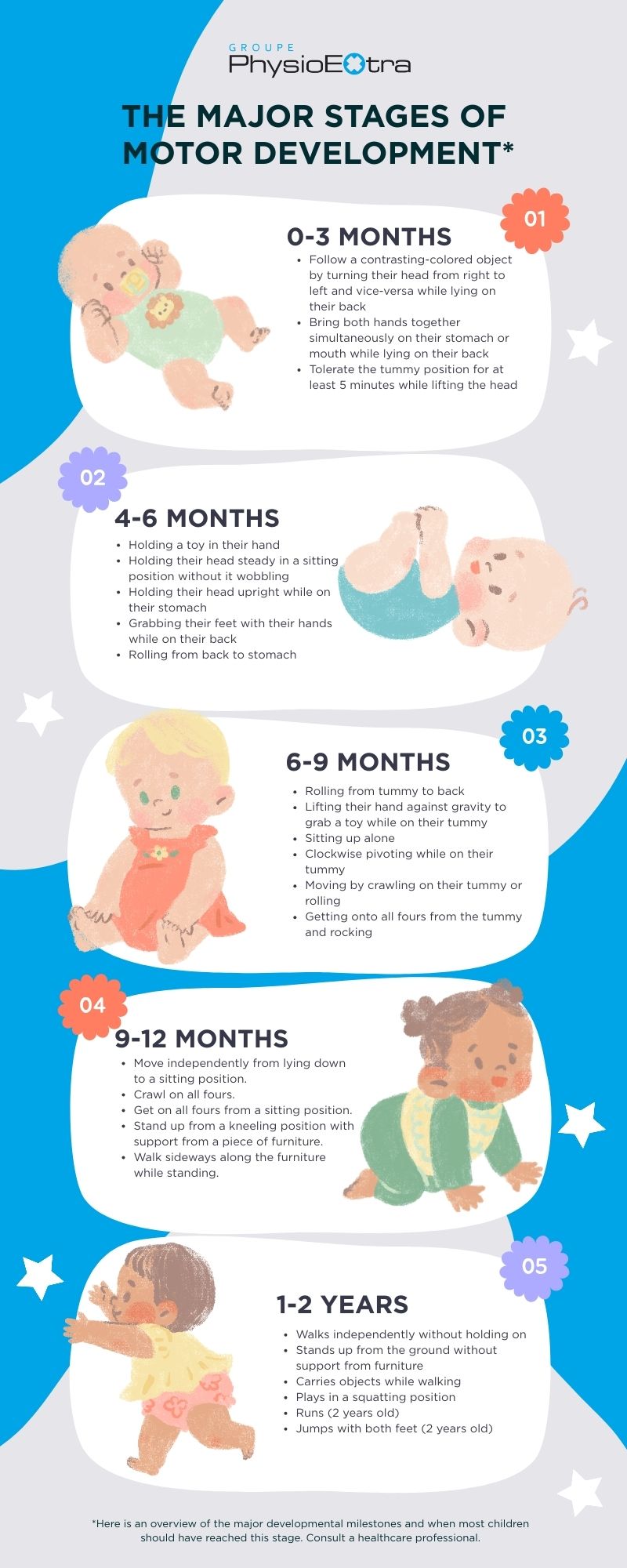
Here is an overview of major milestones and when most children should have achieved them.
Tracking a high-contrast object by turning the head from right to left and back again while lying on their back: 2 months
Bringing both hands together at the same time to the tummy or mouth while lying on their back: 3 months
Holding a toy in the hand: 4 months
Holding the head steady in sitting without bobbing: 4 months
Holding the head upright while on the tummy: 4 months
Grabbing the feet with the hands while on the back: 5 to 6 months
Rolling from back to tummy: 6 months
Rolling from tummy to back: 6 to 7 months (some babies roll accidentally from tummy to back around 2 to 3 months, but this isn’t a voluntary roll—it's usually the weight of the head that causes the roll)
Lifting a hand against gravity to reach a toy while on the tummy: 5 to 6 months
Sitting independently: 6 months (30 seconds to 1 minute)
Sitting independently for several minutes: 7 months
Pivoting (“clock turning”) while on the tummy: 7 months
Getting into hands and knees from the tummy and rocking: 8 months
Crawling on hands and knees: 9 months
Getting into hands and knees from sitting: 9 months
Pulling to stand from kneeling with support on furniture: 10 months
Cruising sideways along furniture: 10 to 11 months
Independent walking (without holding on): 12 to 15 months
Standing up from the floor without support on furniture: 12 to 15 months
Running: 2 years
Two-foot jumping: 2 years
For a premature baby, you should take corrected age into account up to age 2. In other words, you use the expected due date to calculate age, as if the baby had been born on that date. For example, a premature baby who is 5 months of chronological age but 3 months of corrected age should follow the developmental milestones of a 3-month-old baby—not a 5-month-old.
If you notice development that seems more challenging, unusual movement patterns, or if you simply need reassurance, a pediatric physiotherapy assessment can help you better understand what’s going on and get exercises tailored to your child.
Janie is a physiotherapist graduated from the Université de Montréal and a member of the Ordre Professionnel de la Physiothérapie du Québec since 2007. FIELDS OF PRACTICE Pediatric - motor development problems Pediatric - congenital torticollis, plagiocephaly (flat head syndrome) CONTINUING EDUCATION approach in pediatric physiotherapy (experience with premature clients) Torticollis and plagiocephaly Numerous trainings on the motor development of the child 0-5 years Alignment disorder of the lower limbs