What is tennis elbow?
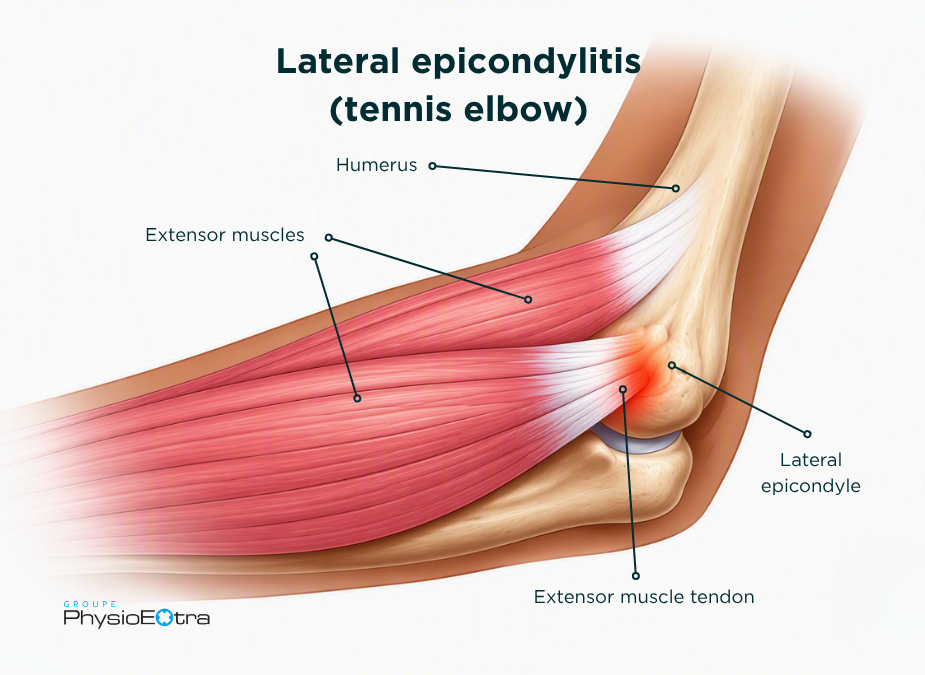
Lateral epicondylitis, commonly known as tennis elbow, is an injury or inflammation of the tendons of the wrist extensor muscles. It generally develops gradually as a result of repeated contractions and overuse of the forearm muscles.
The pain is often sharp and felt near the lateral epicondyle of the humerus. It may occur during wrist extension movements, such as when the back of the hand is facing upward, or during gripping activities. The pain may also radiate into the forearm and wrist.
In many cases, the extensor carpi radialis brevis is the muscle most commonly involved in this persistent pain.
Common causes in tennis players
Tennis players perform dozens, and sometimes hundreds, of shots during a single session. The forearm muscles are therefore heavily used to stabilize the wrist and racquet.
The backhand stroke places particular stress on the wrist extensors. It can contribute to tendon microtrauma, especially when the training volume exceeds the tendon’s ability to recover between sessions.
Stroke technique and racquet grip also play an important role. A grip that is too tight or a slightly flexed wrist at impact places unnecessary stress on the tendons and causes the muscles to fatigue more quickly.
An off-centre impact on the racquet or late contact during a backhand stroke can also force the player to recruit the extensor muscles more heavily to compensate. Repeated over time, these habits may contribute to tendon damage.
Factors that can worsen the pain
A training volume that increases too quickly, without an appropriate adaptation period, can increase injury risk. A string tension that is too high may also absorb less impact from the ball and transmit more vibration to the arm.
Some possible aggravating factors include:
- Insufficient recovery between sessions.
- Accumulated fatigue.
- A muscular imbalance between the left and right sides, or between the forearm extensors and flexors.
Symptoms of tennis elbow
The signs and symptoms of tennis elbow often include sharp pain or a burning sensation. This pain may occur during physical activity, while gripping objects, during wrist extension, or when pressure is applied to the lateral epicondyle.
Weakness may also be noticed during everyday activities, such as turning a doorknob, opening a glass jar, or holding a cup.
When should you consult?
It is important to distinguish tennis elbow from the normal soreness that can occur after physical activity. Following an intense tennis session, it is normal to experience muscle soreness. This discomfort usually lasts 24 to 48 hours before resolving.
If the pain occurs during activity and persists for several days or even several weeks, it is important to consult an athletic therapist or a physiotherapist. This assessment helps determine the extent of the injury and identify its specific causes.
Tennis elbow treatment in athletic therapy
An effective assessment does not focus solely on the elbow. The therapist evaluates the entire movement chain involved in the stroke, including shoulder mobility, core strength, backhand technique, and even racquet grip.
Elbow pain is often the result of an underlying issue located elsewhere. It is therefore important to take a comprehensive approach to understand why the tendon became overloaded. Treating pain alone is not enough.
Tennis is a highly technical and complex sport. The therapist’s role is to support the athlete throughout rehabilitation while ensuring technical errors are corrected and exercises are adapted to the demands of the sport.
Approaches used
Depending on the individual's needs, various approaches may be used in athletic therapy:
- Therapeutic exercises with an emphasis on eccentric strengthening.
- Manual therapy aimed at improving mobility and reducing muscle tension.
- Taping techniques or bracing, when appropriate.
Preventing recurrence and supporting a return to play
To help prevent recurrence once the tendons have recovered, it is important to continue following the rehabilitation plan and strengthening exercises. This helps reduce the likelihood of the original issues returning.
A return to tennis should be gradual. It is essential not to rush the return to play. Progressively increasing training volume and intensity allows the tendons to adapt and recover properly.
Good communication between athletic therapists and coaches or partners such as Tennis Québec can also help identify and correct technical issues in order to prevent injuries and pain.
Are you experiencing elbow pain during activity or pain that has persisted for several days? Contact our team to be directed to the right professional. They can assess the injury, identify the specific causes of your pain, and help you return to play through a gradual and safe rehabilitation process.