
Why are ankle sprains so common in tennis?
Types of movements
Ankle sprains are among the most common injuries in tennis players of all levels. The fast-paced, multidirectional, and often unpredictable nature of this sport, which involves jumping, sliding, and sudden, powerful changes of direction, places significant stress on the ankle joint, making it particularly vulnerable to injury.
Court surfaces
Although studies have not demonstrated a direct correlation between court surface type and the risk of ankle sprains, each surface presents unique challenges.
- Hard courts generally provide less shock absorption, which increases the impact transmitted to the joints and may lead to fatigue of the ankle’s stabilizing muscles. They also tend to offer greater traction. If a player's foot remains planted while the rest of the body rotates, an ankle sprain may occur.
- In contrast, grass courts and clay courts are often more unstable, slippery, and unpredictable. As a result, players may have less effective proprioceptive and neuromuscular control.
Factors that may increase the risk of an ankle sprain
- Fatigue, especially near the end of a match, can reduce alertness and increase the risk of injury.
- A previous ankle sprain or prior lower-extremity injury increases the risk of recurrence.
- Wearing footwear that is not suited to the court surface or the sport may also have a negative impact.
Recognizing the signs of an ankle sprain
Sprain or strain? In this case, both terms refer to the same type of injury. An ankle sprain is an injury to the lateral or medial ligaments of the ankle, most often caused by trauma.
Common signs and symptoms include:
- Pain in the ankle or foot
- Difficulty walking or putting weight on the affected leg
- Swelling around the ankle bone
- Bruising or discolouration of the injured area
- A feeling of instability in the joint
The different grades of an ankle sprain
- Grade 1 (mild): A stretching of the ligaments. Symptoms and functional limitations are generally less significant.
- Grade 2 (moderate): A partial tear of the ligaments. Swelling and bruising around the ankle and foot may be present.
- Grade 3 (severe): A complete tear of the ligaments. This injury often presents with signs and symptoms similar to a Grade 2 sprain.
Could it be a fracture?
With a severe ankle sprain, it is important to rule out the possibility of a fracture. To do so, a sport therapist can use the Ottawa Ankle Rules, a well-established clinical tool that helps identify, with a high degree of accuracy, cases that may require an X-ray. If a fracture is suspected or medical imaging is indicated, the sport therapist can refer the individual to a physiotherapist to obtain an X-ray requisition and ensure appropriate follow-up and care.
The key role of athletic therapy in treatment
Immediately following an injury, an athletic therapist can perform a sport-specific functional assessment to evaluate joint mobility, muscle strength, and the athlete’s ability to perform tennis-related movements.
This assessment makes it possible to quickly establish an action plan tailored to the situation, whether it involves a return to play, taping techniques, or a temporary withdrawal from sport.
Follow-up assessments in the clinic allow the therapist to create a personalized rehabilitation program based on the athlete’s needs.
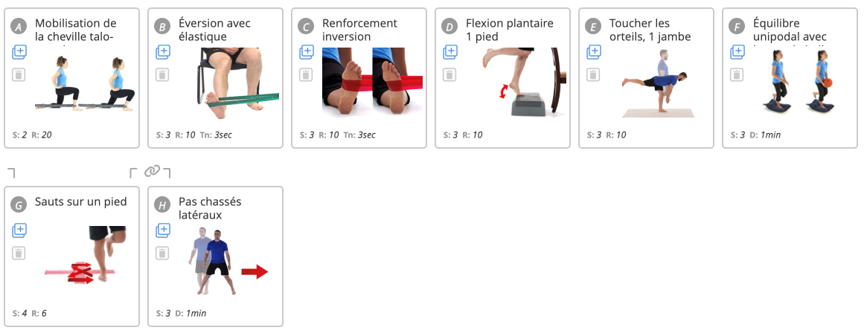
Rehabilitation generally focuses on:
- Restoring full ankle range of motion
- Strengthening the stabilizing muscles to compensate for injured ligaments
- Improving neuromuscular control and proprioception
Ultimately, the therapist’s goal is to address all identified deficits to reduce the risk of chronic instability and prevent recurrent injuries.
Preventing recurrence and optimizing your return to play
When returning to training or competition, wearing an ankle brace or using supportive taping may provide additional stability. However, these aids should not become a permanent solution.
Before fully returning to tennis, athletes should regain:
- Full ankle range of motion
- Strength comparable to the uninjured side
- Adequate stability
- Good proprioception
- The ability to perform sport-specific movements and tests with little or no pain
To support a safe and efficient return to play, athletic therapists and coaches often work together to adjust training workload and volume.
Practical advice for recreational and competitive players
Completing an active tennis-specific warm-up before every training session or match is essential. An effective preparation should include mobility exercises, strengthening activities, running drills, and plyometric exercises that reflect the demands of the sport. Static stretching should be avoided before play.
It is also important to maintain a gradual progression of training volume and avoid sudden increases in workload. Allowing sufficient recovery time between sessions is equally important.
Finally, pay attention to your body's signals. If pain or limitations develop after a match or training session, consulting a healthcare professional promptly can often help avoid a longer rehabilitation process.
Are you experiencing an ankle sprain or looking to prevent future injuries? The PhysioExtra team can support you with a comprehensive assessment and a personalized rehabilitation plan tailored to your goals to help ensure a safe return to play.
Sources
- Dines, Joshua & Bedi, Asheesh & Williams, Phillip & Dodson, Christopher & Ellenbecker, Todd & Altchek, David & Windler, Gary & Dines, David. (2015). Tennis Injuries: Epidemiology, Pathophysiology, and Treatment. The Journal of the American Academy of Orthopaedic Surgeons. 23. 10.5435/JAAOS-D-13-00148.
- Kaiser P, Stock K, Benedikt S, et al. Acute Tennis Injuries in the Recreational Tennis Player. Orthopaedic Journal of Sports Medicine. 2021;9(1). doi:10.1177/2325967120973672